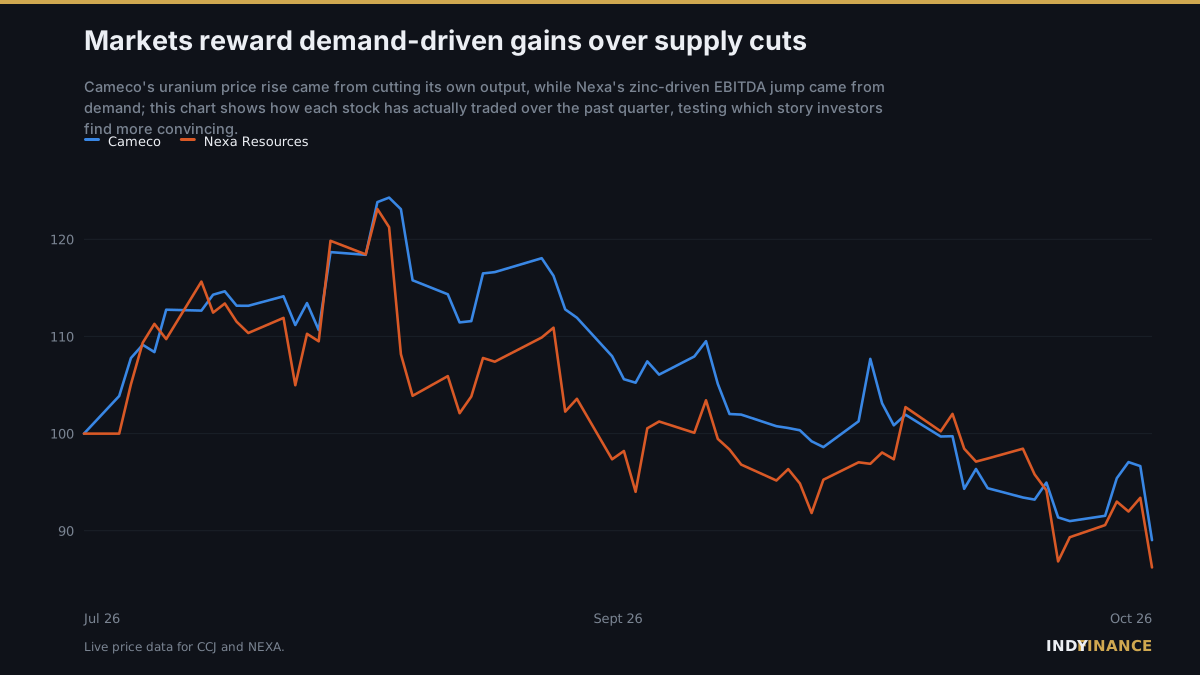
Two commodity producers reported third-quarter results this week that both pointed to higher prices, but the reasons behind those prices are not the same. Cameco said uranium prices rose 8% in the quarter, a gain that coincided with a 20% drop in its own production, caused by planned maintenance at the Key Lake mill in Saskatchewan. Nexa, by contrast, said its adjusted EBITDA surged 62%, driven by higher zinc prices and byproduct credits from the silver and lead that come out alongside its zinc ore, with no mention of cutting its own output.
The distinction matters for anyone trying to read commodity markets off a single earnings call. A price gain that tracks a producer's own supply cut tells you less about underlying demand than a price gain that shows up while the company is still running at full output. Cameco's uranium number looks more like the mechanical result of less material reaching the market from one of its own mills than a signal that buyers are suddenly more eager for nuclear fuel.
Nexa's case points the other way. Zinc, used mostly in galvanizing steel, doesn't have the same single-buyer dynamics as uranium, which trades mostly through long-term utility contracts. A 62% jump in adjusted EBITDA on higher prices and byproduct credits, without a supply pullback behind it, is closer to a read on actual industrial demand for the metal.
What's unresolved is whether Cameco's Key Lake maintenance is isolated or part of a broader pattern of supply tightness across uranium producers heading into 2027, which would make the price move look more structural than seasonal.