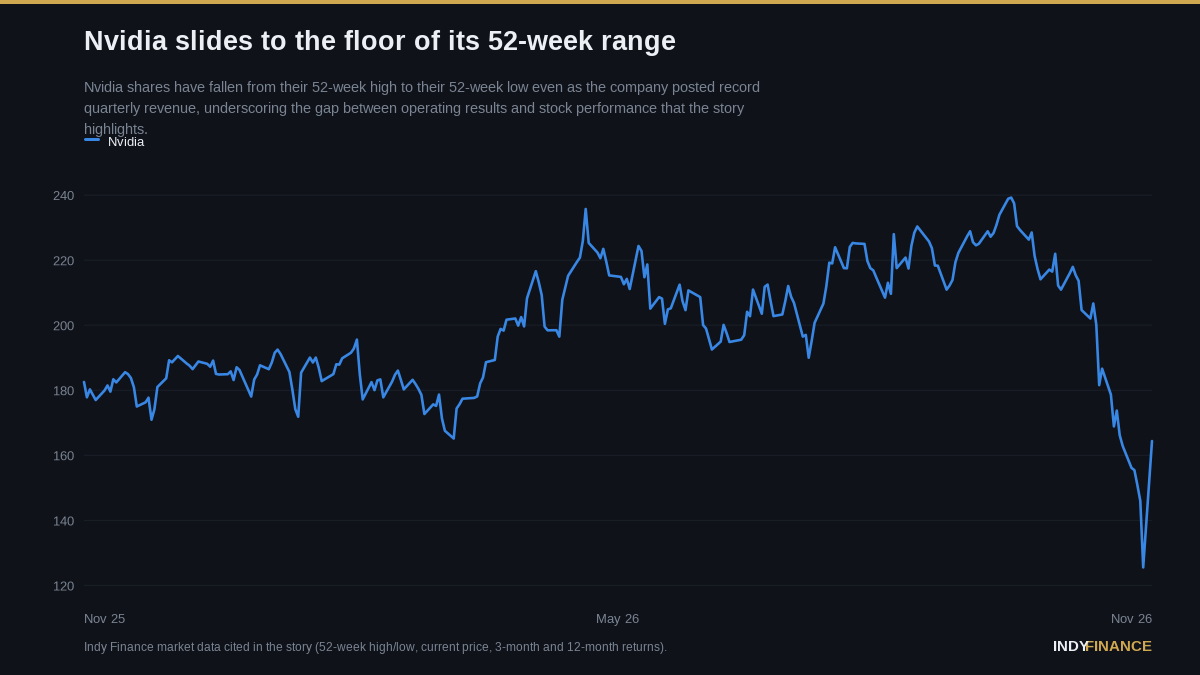
Nvidia's stock is trading at the bottom of its yearly range. Indy Finance market data shows a last price of $125.53, down 14.01% on the day. That leaves the shares 47.5% below their 52-week high of $239.24 and 0.0% above their 52-week low. They are down 41.1% over three months and 29.8% over 12 months. None of the sources reviewed gives a cause for the latest drop.
The operating results do not explain the slide on their own. Nvidia's November 17 release reported revenue of $115.8 billion for the quarter ended October 25, up 103% from a year ago. Data Center revenue was $107.6 billion. The company guided fourth-quarter revenue to $130.0 billion, plus or minus 3%, for a quarter that includes an extra week. It expects gross margins of 71.0% to 72.0%, down from 74.8% in the third quarter. Indy Finance's record of the company's filings shows Nvidia beat its own forecast in 15 of 18 resolved quarters, met it twice and missed once, with actuals landing on average +4.2% from the guided figure.
What is missing is the 10-Q, the quarterly report certified under securities law. The Motley Fool noted that the earnings numbers are out but the legally certified version is not. Barchart's analysis, republished by Yahoo Finance, ran under the headline that the delayed 10-Q "may matter more" than the quarter. It said an SEC probe into the company could keep traders on tenterhooks despite another earnings beat.
The leadership picture is also different from the one in early coverage. Jensen Huang is not running Nvidia. The results release quotes Colette Kress as "interim CEO and executive vice president and chief financial officer." Investing.com reported that the Trump administration is pushing for Nvidia to bring back Huang. We could not access that article beyond its headline, so the details of the push are unconfirmed. Nvidia's release does not mention Huang, the probe or the timing of the 10-Q.
The filing is the next hard fact. If it confirms the November 17 figures and adds nothing new on the probe, the delay is paperwork. If it carries changes or new disclosures, the strong guidance record will matter less than what the certified numbers say.