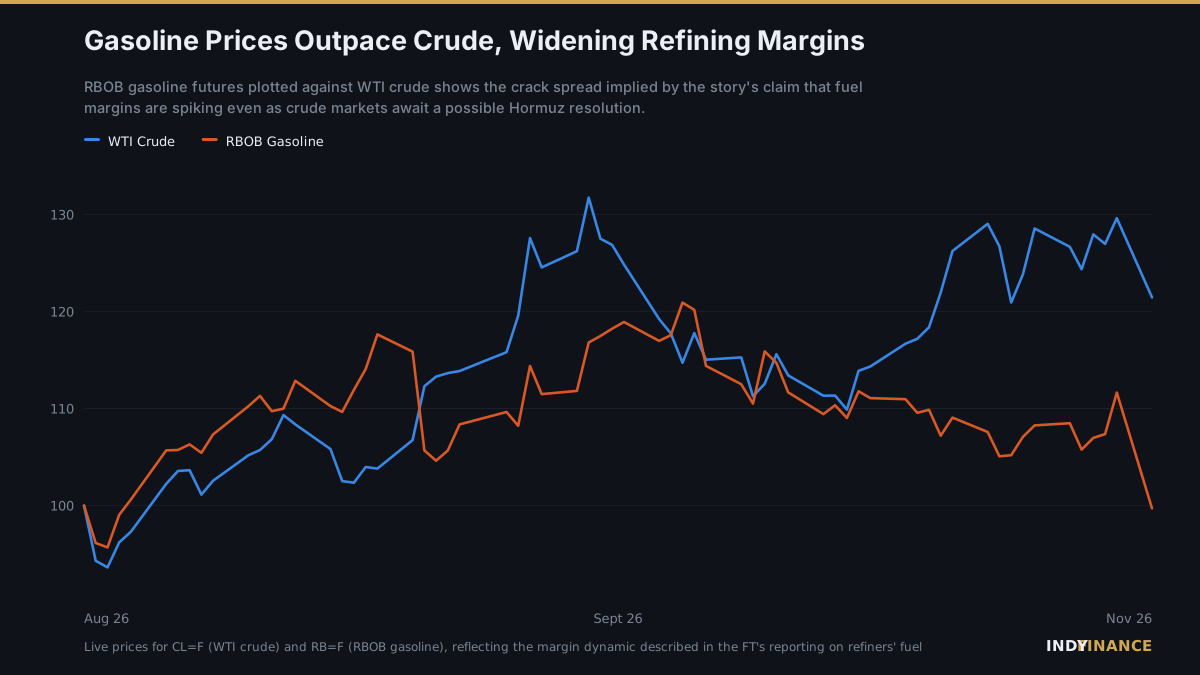
Fuel margins have widened sharply as conflicts in the Middle East and Ukraine have knocked out refining and production capacity, according to the Financial Times. Yet oil majors are resisting pressure to build new refineries, choosing instead to keep capital spending disciplined and return cash to shareholders rather than bet on long-lived plants.
That decision matters because it decouples the fix for tight fuel supply from the fix for tight crude supply. Iran has offered a 48-hour plan to reopen the Strait of Hormuz, and President Trump has signalled progress in talks, according to Investing.com. If that holds, it could ease the crude flows that have been disrupted by the regional conflict. But reopening a shipping lane does not add a single barrel of refining capacity, and refiners show no sign of changing that calculus.
Germany's failure to meet its winter gas storage target adds a separate layer of pressure on the same theme: Europe's biggest economy will now need more spot-market gas purchases, which the FT says could push prices higher for the rest of the bloc just as fuel margins are already elevated. Three different commodities, one shared story of capacity that hasn't kept up with disrupted supply chains.
What's unresolved is whether margins stay high long enough to change the majors' capital allocation, or whether this is a temporary squeeze that unwinds once Hormuz reopens and winter gas demand passes. Refiners' own capex plans for 2027 will be the clearest signal either way.