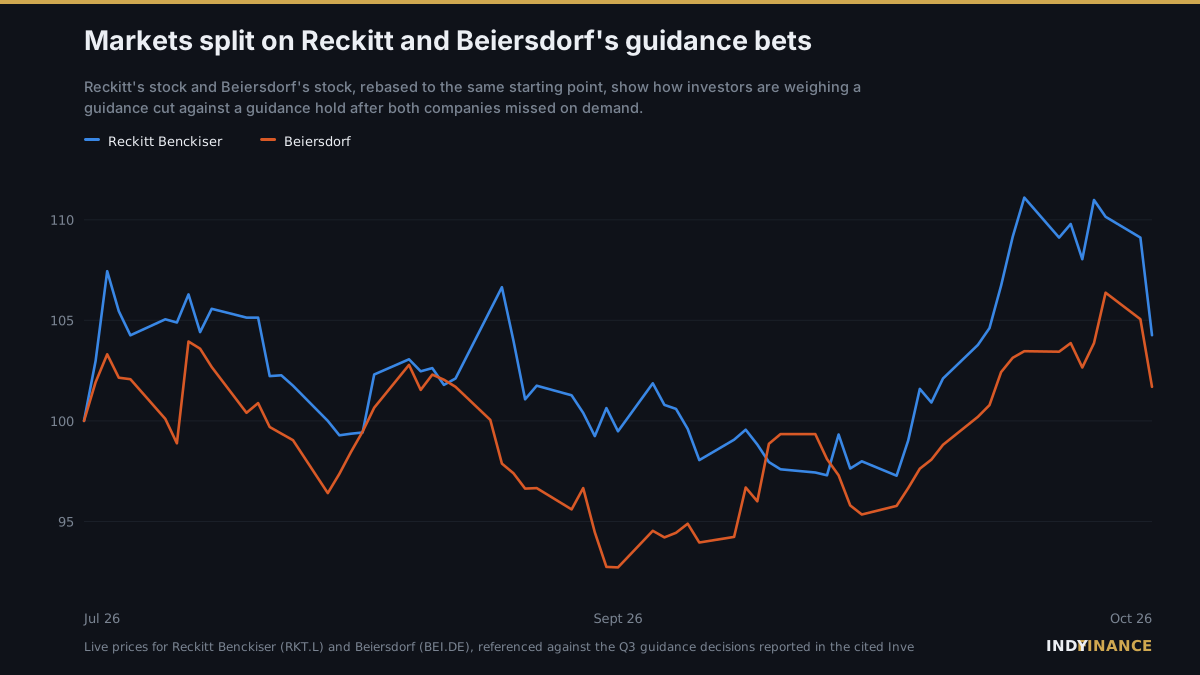
Reckitt Benckiser lowered its annual revenue forecast after third-quarter sales missed estimates, citing supply constraints on its Lysol disinfectant brand. On the same day, Beiersdorf reported falling Q3 sales as its flagship Nivea brand slumped, yet the German group chose to keep its full-year guidance unchanged.
The divergence matters because both companies are read as bellwethers for global household and personal-care demand. A miss at one company might be company-specific; a miss at two, in the same quarter, raises the question of whether consumer demand for everyday staples is softening more broadly. Reckitt's move to cut guidance suggests its management sees the Lysol shortfall as more than a one-quarter problem. Beiersdorf's decision to hold its forecast implies the opposite bet: that the Nivea weakness is temporary and sales recover without a full-year reset.
The difference in response is itself informative. Supply-chain constraints, like the one Reckitt cited at Lysol, are typically treated as fixable and temporary, yet Reckitt still chose to cut guidance rather than wait it out. That choice signals more caution about near-term demand than the headline cause alone would suggest.
What is unresolved is whether Beiersdorf's confidence is well-placed or whether it will be forced to follow Reckitt's lead if Nivea sales do not stabilize before year-end results.