AI Power-Chip Demand Sends Vicor Revenue Up 78.5%
TSMC also posted strong Q3 results tied to AI demand, while analysts flag SK hynix's memory supply as a risk that could surface next year.
Vicor's Q3 2026 revenue surged 78.5% year over year on AI demand for its power delivery modules, part of a broader pattern of chip and component suppliers benefiting from AI infrastructure buildouts.
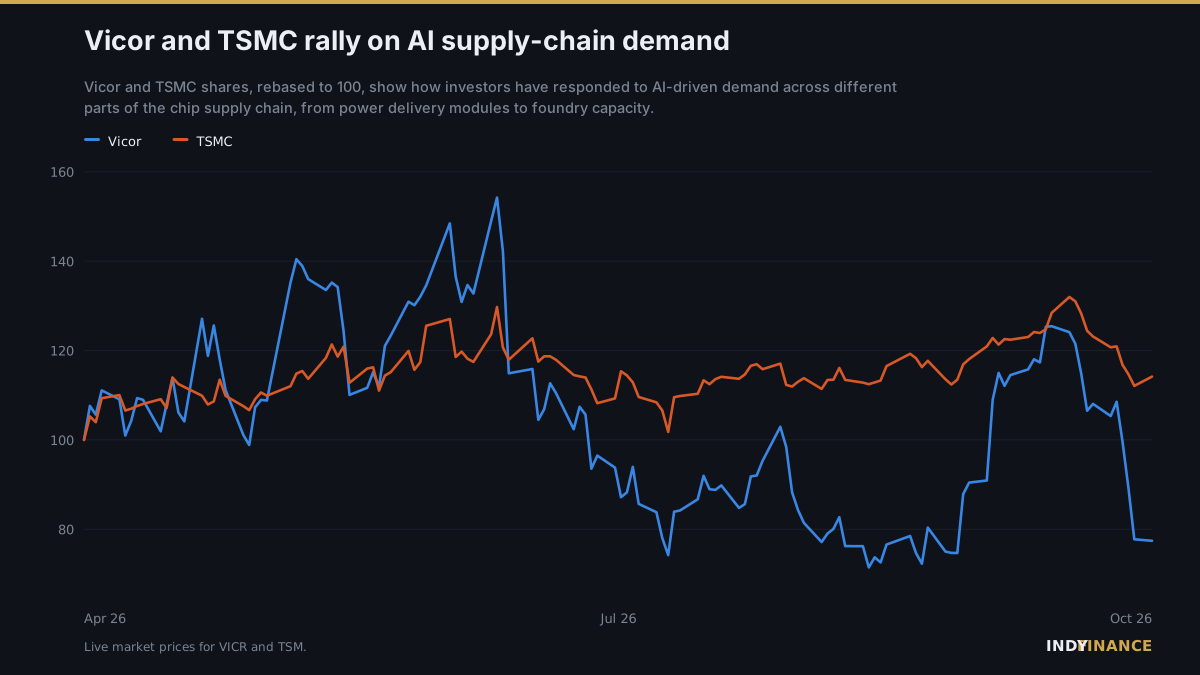
Vicor and TSMC rally on AI supply-chain demand
Vicor and TSMC shares, rebased to 100, show how investors have responded to AI-driven demand across different parts of the chip supply chain, from power delivery modules to foundry capacity.
Live market prices for VICR and TSM.
Use this chart
Free to embed with attribution:
<figure><a href="https://www.indy.finance/news/ai-power-chip-demand-sends-vicor-revenue-up-78-5"><img src="https://www.indy.finance/news/ai-power-chip-demand-sends-vicor-revenue-up-78-5/graphic.svg" alt="Vicor and TSMC rally on AI supply-chain demand" width="1200" height="675"></a><figcaption>Vicor and TSMC rally on AI supply-chain demand — <a href="https://www.indy.finance/news/ai-power-chip-demand-sends-vicor-revenue-up-78-5">Indy Finance</a></figcaption></figure>If SK hynix's upcoming guidance confirms a demand slowdown in 2027 rather than the current strength seen at Vicor and TSMC, it would suggest the AI supply-chain boom is already cresting rather than broadening.
- The Motley FoolVicor (VICR) Q3 2026 Earnings Call TranscriptExternal ↗
- Seeking Alpha — All ArticlesSK hynix: The Cracks Are A Next-Year ProblemExternal ↗
- Seeking Alpha — All ArticlesTSMC Stock: AI Demand Drives Strong Q3 ResultsExternal ↗
Produced automatically by the INDY NEWS Desk from the public wire sources cited above, and checked against them before publication. Market commentary, not investment advice.