Palantir CEO Alexander Karp's reported $37.9 million stock sale was not a discretionary trade. His Form 4, filed Nov. 24, describes "automatic sales of shares to cover required tax withholding obligations." The obligations arose when restricted stock units (shares granted as pay) vested on Nov. 20. The filing says the sales complied with his Rule 10b5-1 trading plan, a pre-scheduled selling arrangement.
The filing says Karp gained rights to 975,000 Class B shares at that vesting. He converted 163,319 of them to Class A stock and sold them on Nov. 20. He then converted and sold 239,944 more on Nov. 23, at prices ranging from $154.74 to $161.19. That filing is marked "Form 2 of 2" filed for him on Nov. 24, so the sales came on two days, not one. Afterward he held 6,432,258 Class A shares and 52,916,076 Class B shares directly.
Karp's Nov. 20 filing also lists a separate conversion and sale of 90,000 shares under a different footnote. That footnote was cut off in the copy Indy News reviewed, so it is not confirmed whether those shares were part of the tax sales. The filings reviewed also do not give the date Karp adopted his plan.
Shyam Sankar, Palantir's Chief Technology Officer and Executive Vice President, has an earlier filing that the $9.6 million headline did not mention. A Form 4 filed Nov. 23 shows he converted and sold 300,000 shares on Nov. 19, at weighted average prices from $153.828 to $166.7005. The filing says the sales followed a Rule 10b5-1 plan entered into on Aug. 10, 2026. He was left with 857,616 Class A shares held directly and 599,899 held by a trust. Indy News did not review the filing behind the $9.6 million figure.
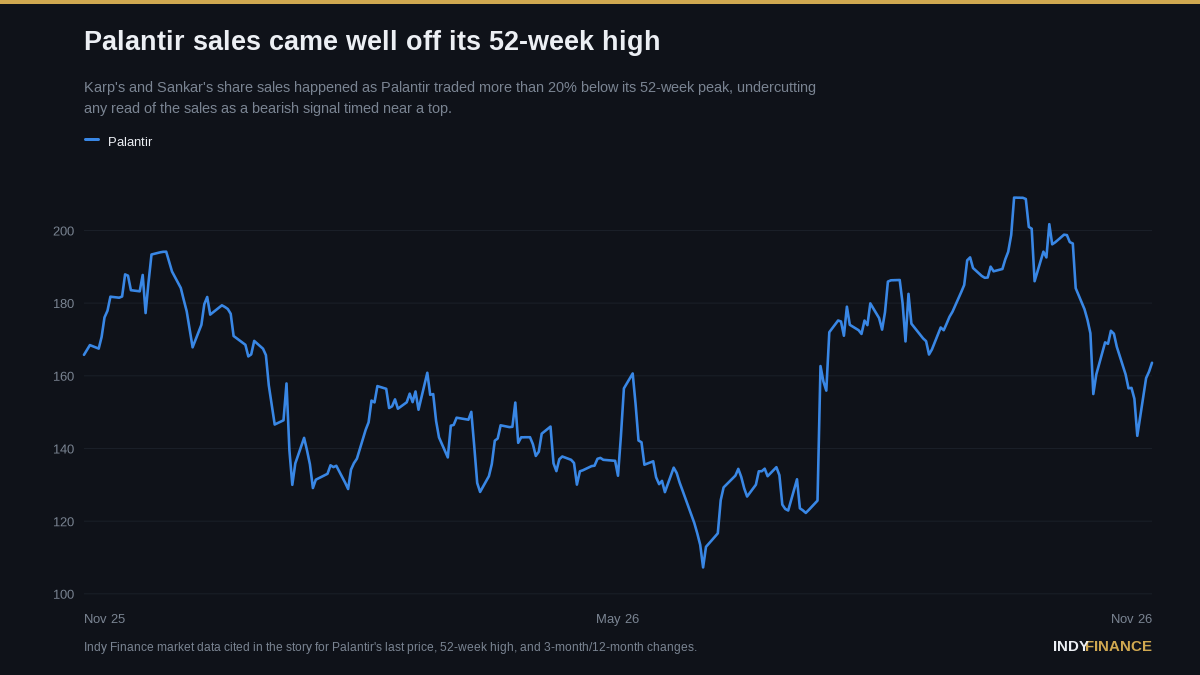
The stock was not near a peak when the sales took place. Indy Finance market data put Palantir's last price at $161.18, up 1.14% on the day. That leaves it 22.9% below its 52-week high of $209.05, down 9.2% over three months and down 1.4% over 12 months.