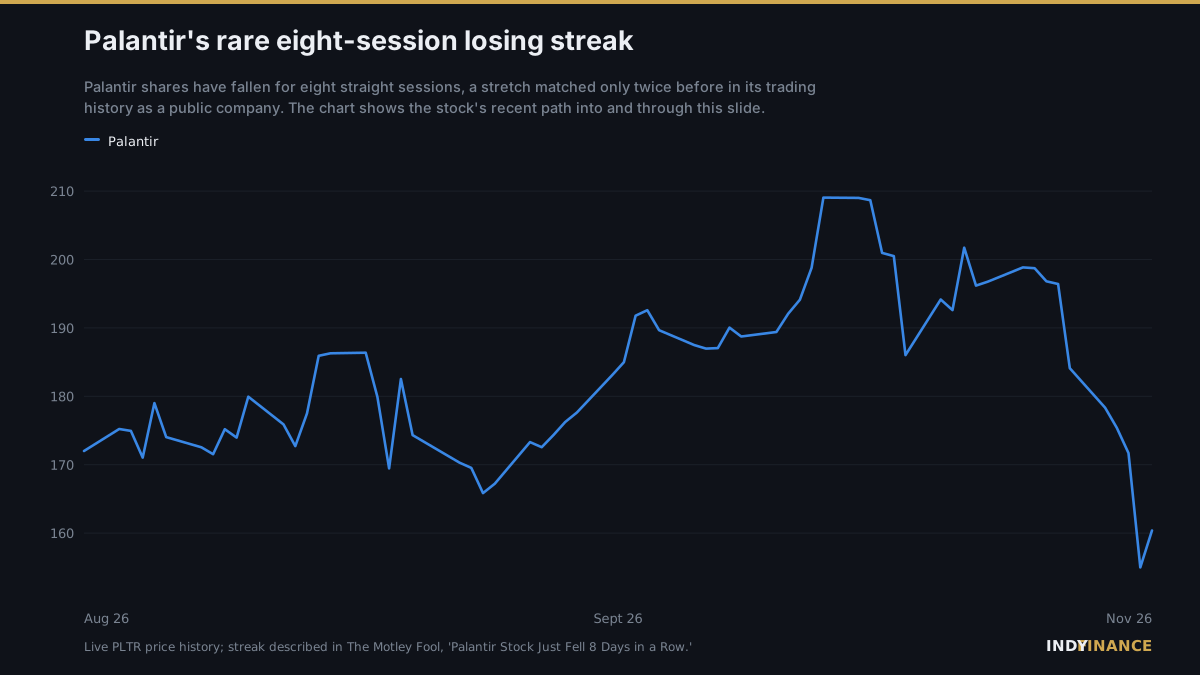
Palantir shares have dropped for eight consecutive sessions, a run matched only twice before in the company's history as a public stock. The streak doesn't by itself explain why investors are selling, but it lands in the middle of a broader AI-stock selloff that the desk has been tracking since junk-bond stress began bleeding into AI names earlier this month.
A separate warning is getting fresh attention alongside it. In 1999, Warren Buffett argued that corporate profits couldn't stay much above 6% of the US economy for long, because competition and regulation eventually pull outsized margins back down. That share is now more than double the level Buffett flagged, and the current AI capital-spending boom is one of the forces commentators point to for keeping it elevated.
Neither data point proves the AI trade is overextended. Palantir's prior two longer losing streaks happened in different market conditions, and a profit share staying above a historical norm for a long stretch isn't automatically a prediction of reversal. But the two signals arriving together — a single heavily-watched AI stock posting a rare losing streak, and an economy-wide profit metric at a record versus Buffett's own benchmark — is the kind of coincidence that tends to sharpen a debate already underway on the desk about whether AI-linked risk is being mispriced.
What remains unresolved is whether this is a normal pullback after a long run-up or something structural. That question won't be settled by either of these data points alone.