Taiwan's main index rose more than 9% on Tuesday, November 24, but the rebound did not rest on buyers alone. Investing.com reported that Taiwan's financial regulator banned short-selling (betting on price falls) below the previous day's closing price. It also lifted minimum margin requirements on short positions. Separately, the National Security Fund confirmed it had bought equities directly, its tenth intervention since the fund was set up.
The trigger came from New York. Nvidia's board reinstated co-founder Jensen Huang as chief executive, and Nvidia shares rose 31.5% on Monday, November 23, according to Investing.com. The S&P 500 gained 4.7%, the Nasdaq Composite 6.5% and the Philadelphia Semiconductor Index 14%. Investing.com called it Wall Street's strongest session since April 2025.
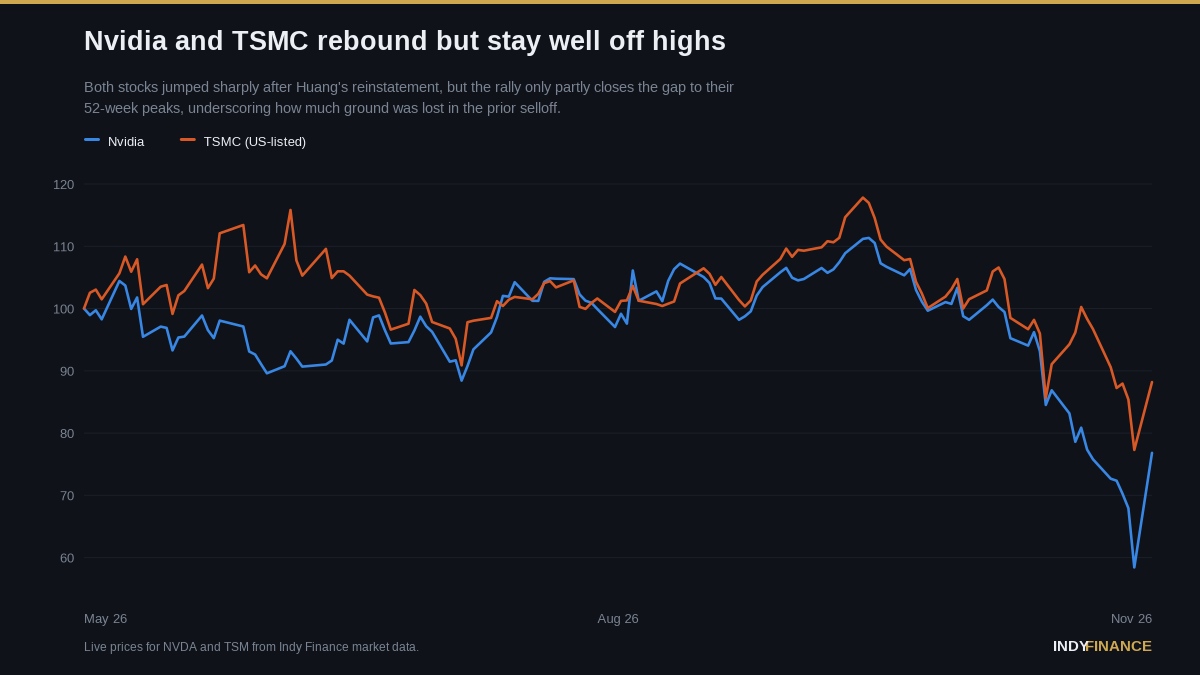
TSMC's Taipei shares hit their daily limit at the open, up 9.9% at TWD 2,230, Investing.com said. Its US-listed shares had already risen 14.08% to 363.6 USD on Monday, according to Indy Finance market data. That still leaves them 25.2% below their 52-week high of 485.8 USD. Nvidia closed at 165.05 USD, which Indy Finance data puts 31.0% below its 52-week high of 239.24 USD, even after the jump.
Investing.com's TSMC report, which the site says was written with AI help, said Nvidia reportedly accounts for 19% of TSMC's revenue. The report also said TSMC had dismissed fears of a deeper AI correction and cited demand for AI applications that still exceeds its advanced chip supply.
The rally spread across the region. Investing.com's quote data showed South Korea's KOSPI up 7.04% and Advantest up 13.25% in Tokyo. Asian currencies stayed subdued, with the dollar near a 20-month high, Investing.com reported. The material we reviewed does not explain why the equity rally failed to lift local currencies.