Official buying of long-dated Treasuries is the clearest institutional acknowledgement yet that the long end has become the system's stress point. By absorbing duration, the Treasury is smoothing auction dynamics and dampening the term-premium spikes that have repeatedly destabilised equity multiples this year. The relief, however, is mechanical rather than structural: the underlying driver remains a federal debt load whose service costs are increasingly transmitted to households through mortgage rates, revolving credit and the real return required on savings vehicles — a dynamic that also explains renewed retail interest in structured products such as indexed universal life insurance and in high-distribution equity income wrappers offering 13.8% to 20% headline yields. Investors should treat those yields as a symptom of the macro regime, not a solution to it. The practical implication for portfolios is that curve interventions can compress volatility without lowering the cost of capital, leaving long-duration equities exposed to any pause in official support.
Treasury Leans Into the Long End as Debt Burden Moves From Abstraction to Household Cost
Increased official buying of long-dated Treasuries stabilises the curve's far reaches, but the fiscal arithmetic behind the intervention is reshaping mortgage, credit and equity duration assumptions
In briefThe U.S. Treasury has increased its purchases of long-dated securities, a technical intervention aimed at containing volatility at the far end of the curve. The move arrives alongside intensifying scrutiny of the federal debt trajectory and its pass-through into consumer borrowing costs, keeping duration risk at the centre of 2026 asset allocation debates.
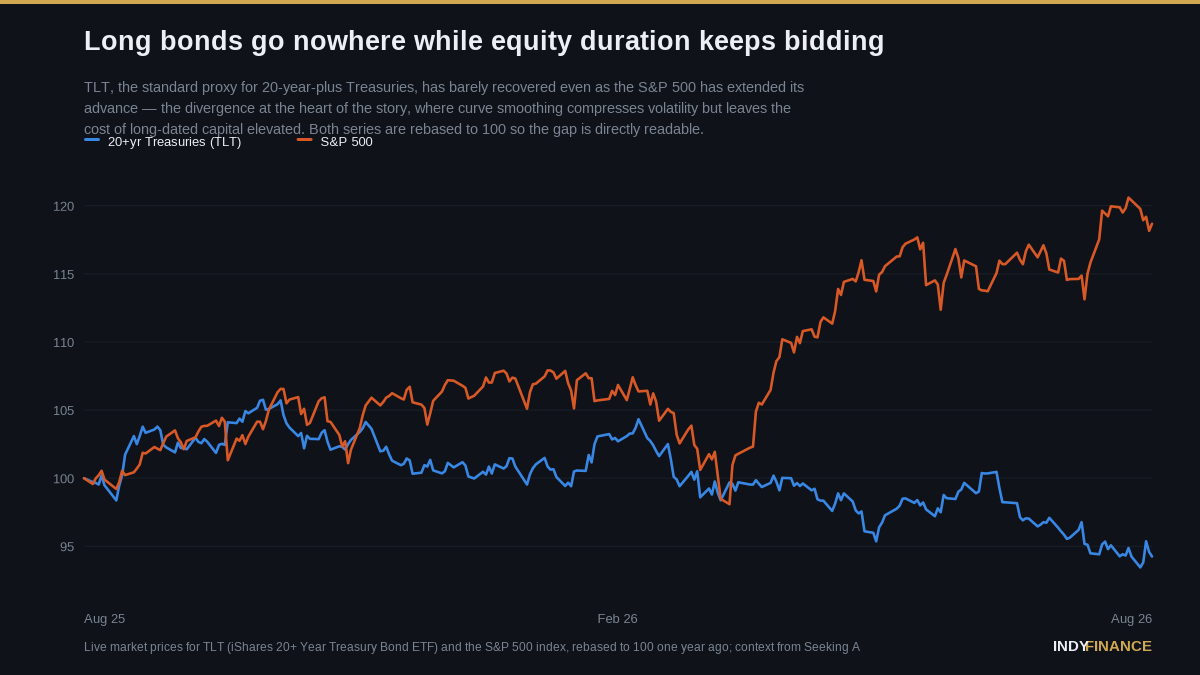
Long bonds go nowhere while equity duration keeps bidding
TLT, the standard proxy for 20-year-plus Treasuries, has barely recovered even as the S&P 500 has extended its advance — the divergence at the heart of the story, where curve smoothing compresses volatility but leaves the cost of long-dated capital elevated. Both series are rebased to 100 so the gap is directly readable.
Live market prices for TLT (iShares 20+ Year Treasury Bond ETF) and the S&P 500 index, rebased to 100 one year ago; context from Seeking Alpha, 'U.S. Treasury Ups Its Buying Of Long-Dated Treasuries'. · Original Indy Finance graphic, rendered from live data.
Use this chart
Free to embed with attribution:
<figure><a href="https://www.indy.finance/news/treasury-leans-into-the-long-end-as-debt-burden-moves-from-abstraction-to"><img src="https://www.indy.finance/news/treasury-leans-into-the-long-end-as-debt-burden-moves-from-abstraction-to/graphic.svg" alt="Long bonds go nowhere while equity duration keeps bidding" width="1200" height="675"></a><figcaption>Long bonds go nowhere while equity duration keeps bidding — <a href="https://www.indy.finance/news/treasury-leans-into-the-long-end-as-debt-burden-moves-from-abstraction-to">Indy Finance</a></figcaption></figure>| Symbol | Last | Day | On the record |
|---|---|---|---|
| TNX | US$4.91 | -2.77% | Valuation, peers and fundamentals → |
| TLT | US$81.45 | +1.37% | Valuation, peers and fundamentals → |
| GSPC | US$6,910.39 | -3.70% | Valuation, peers and fundamentals → |
| TSPY | US$22.46 | -3.93% | Valuation, peers and fundamentals → |
| GGT | US$3.57 | -0.83% | Valuation, peers and fundamentals → |
- Seeking Alpha — All ArticlesTSPY: 13.8% Yield For A Slower S&P 500 Rally19 Aug 2026
- Yahoo Finance — NewsIndexed universal life insurance (IUL): Risks, costs, and how it works19 Aug 2026
- Yahoo Finance — NewsHow the soaring federal debt affects you personally19 Aug 2026
- Seeking Alpha — All ArticlesU.S. Treasury Ups Its Buying Of Long-Dated Treasuries19 Aug 2026
- Seeking Alpha — All ArticlesGGT: Collect 20% Yield From Communications, Multimedia, Sports, And Entertainment19 Aug 2026
Produced automatically by the INDY NEWS Desk from the public wire sources cited above. Every figure and causal claim is traced to those sources by a separate verification pass before publication (for reports filed from 22 October 2026); a report that fails is held. Responsible editor: Jasper Reichardt (Blackriver.Technology). Market commentary, not investment advice. How this desk works →