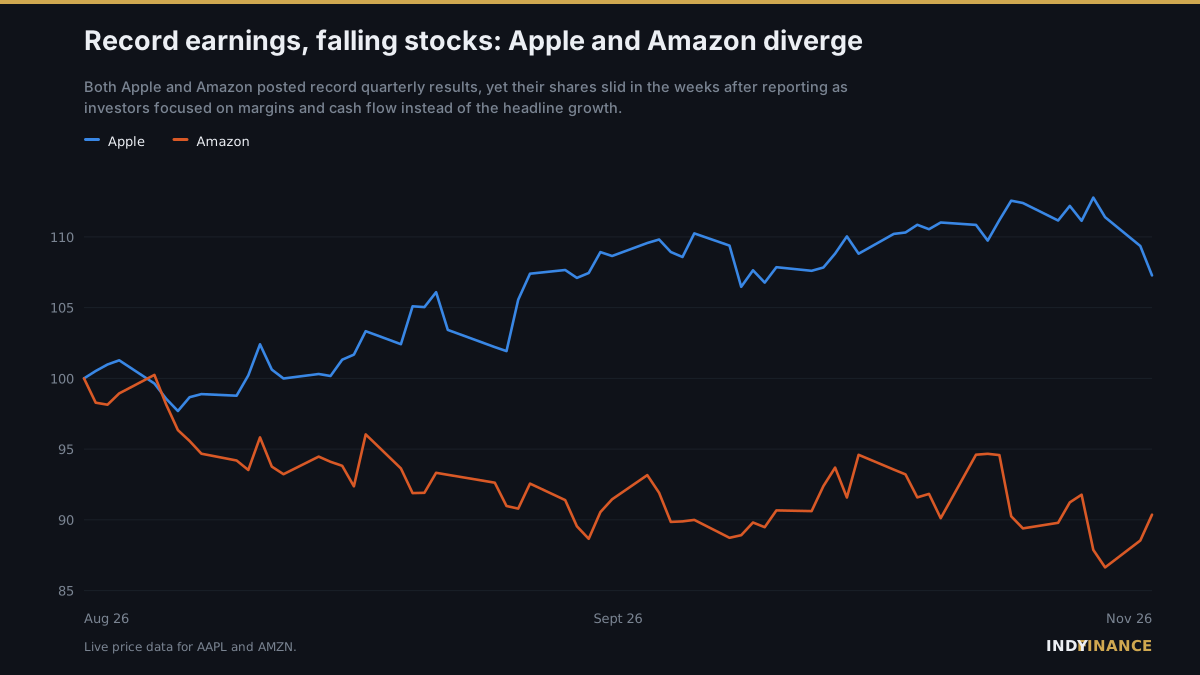
Apple reported a record iPhone quarter for the period ending in the most recent reporting cycle, and its stock fell anyway. The company's own annual report shows why: it loaded up on $10 billion of components in advance, warning that memory chip prices are now 'unprecedented.' Memory is a direct input cost in every iPhone, so when it rises faster than Apple can pass the cost on, the profit kept on each device shrinks even as unit sales climb.
Amazon's quarter tells a similar story with a different cause. The company posted record earnings, yet its stock trades 11% below its peak. The gap isn't about revenue, which grew — it's about cash flow. Wall Street is weighing how much cash the business is generating against how much it's spending, alongside concern that core e-commerce growth is slowing even as other segments carry the results.
In both cases the headline growth number was fine or better than fine. What moved the stock was a line further down the income or cash-flow statement: gross margin per unit for Apple, free cash flow for Amazon. That's a different failure mode than a straightforward revenue miss, and it's harder for a casual reader of the headline print to see coming.
What's unresolved is whether either pressure is temporary. Memory prices move in cycles tied to chip supply, and it isn't clear from Apple's disclosures how long the current spike will last or whether its $10 billion stockpile is enough to buffer the next few quarters. Amazon hasn't said how fast it expects cash flow to recover. Until one of those numbers moves, both stocks are likely to keep trading on the metric beneath the headline, not the headline itself.