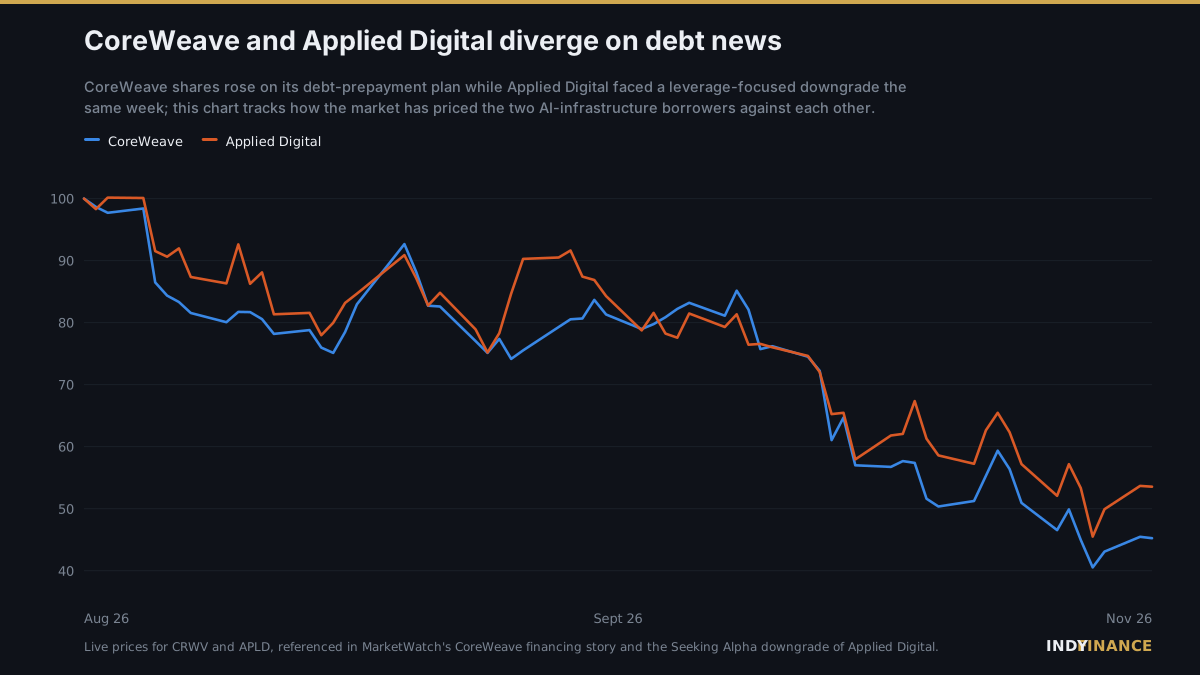
CoreWeave's shares popped in the November 10 session after the company posted a third-quarter revenue beat and laid out a plan to prepay $9 billion of debt, according to the earnings report. That financing detail, not just the revenue number, is what investors reacted to: it signals the company can manage the heavy borrowing it took on to build out AI computing capacity faster than markets had assumed.
The same week, a Seeking Alpha analyst downgraded Applied Digital's rating, titling the call "Leverage Risks Can No Longer Be Ignored." Applied Digital, like CoreWeave, has built its business around leasing AI data-center capacity funded substantially by debt. The downgrade argues that risk has reached a point where it can't be waved off as a side issue.
The contrast matters because these are two companies solving the same problem — financing the physical infrastructure behind the AI buildout — with opposite market verdicts in the same week. CoreWeave's prepayment plan bought it credibility that its balance sheet can keep pace with its growth; Applied Digital hasn't offered the market an equivalent reassurance yet.
What's unresolved is whether CoreWeave's prepayment plan actually executes on schedule, and whether Applied Digital's leverage actually deteriorates in its next filing or the downgrade proves premature. Both are still open questions, not settled outcomes.