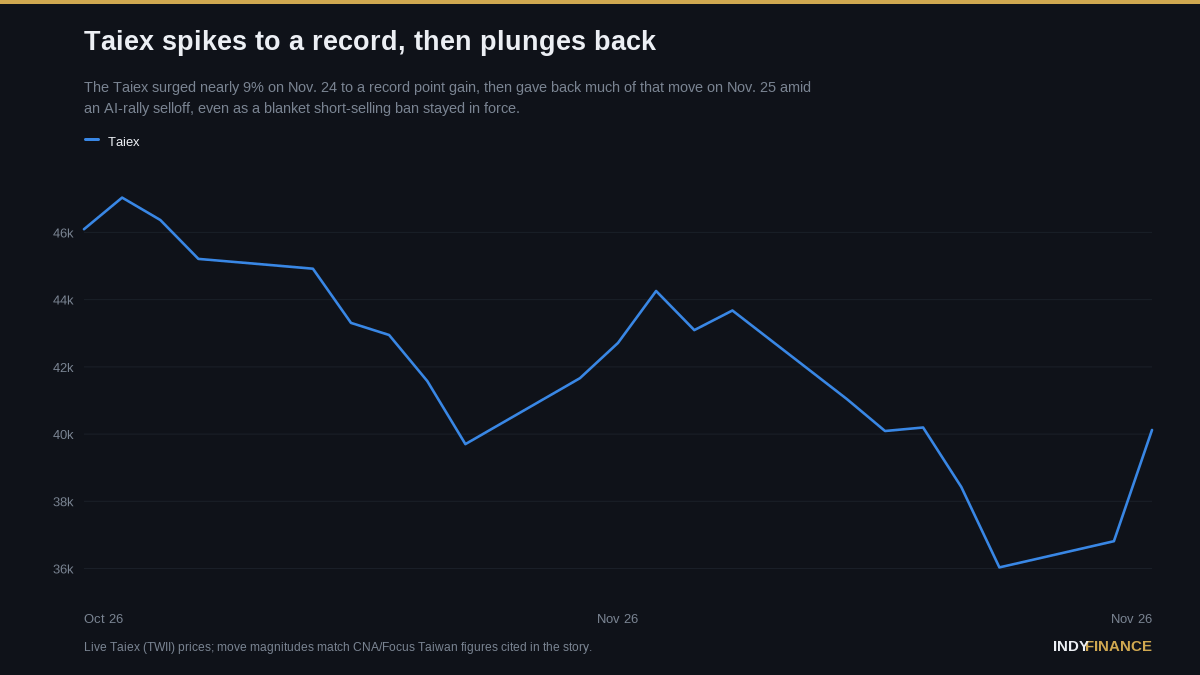
Taiwan's benchmark Taiex closed down 1,926.92 points, or 4.80 percent, at 38,195.43 on Wednesday, Nov. 25, according to Focus Taiwan, the English service of the state news agency CNA. Al Jazeera reported the index had fallen as much as 7.9 percent in morning trading. It said TSMC, the world's biggest contract chipmaker, and Apple supplier Foxconn both dropped more than 9 percent.
The fall reversed part of Tuesday's rally. CNA's account of that session does not credit state support. On Nov. 24 the Taiex closed up 3,310.46 points, or 8.99 percent, at 40,122.35. That was its largest single-day point gain on record. Dealers tied it to Jensen Huang's return as Nvidia's chief executive after Nvidia shares rose 31.48 percent overnight. Al Jazeera described Wednesday's regional sell-off as driven by doubts over the AI boom. South Korea's Kospi fell more than 6 percent and Japan's Nikkei 225 dropped 3.6 percent.
The two sessions traded very different volumes. Tuesday's turnover was NT$419.41 billion, the lowest so far this year, CNA reported. Hua Nan Securities analyst Kevin Su attributed that to many tech stocks hitting their daily increase limit, which left orders unfilled. CNA said 335 main-board firms rose by the 10 percent maximum. Foreign institutional investors sold a net NT$50.39 billion of shares that day, according to the Taiwan Stock Exchange. Wednesday's turnover was NT$1.19 trillion.
Su said Tuesday's close pushed the Taiex above its 240-day moving average, a long-run trend line, of 39,506 points. He said he expected the index to soon challenge 42,000. Wednesday's close of 38,195.43 left it back below that level. It remains above Friday Nov. 21's close of 36,033.29, which CNA said was the lowest in nearly seven months.
State measures stayed in place throughout. On Nov. 21 the Financial Supervisory Commission (FSC) banned short-selling, or betting on price falls, of any stock that fell in the previous session. CNA said this was the first such blanket restriction since 2015. The rule took effect Monday, Nov. 23. The FSC also raised the short-selling margin requirement from 130 percent to 150 percent. CNA's report of the statement gives no end date, and the FSC said it would adjust its measures as conditions change. The NT$500 billion National Financial Stabilization Fund has been authorized to intervene in the market since Nov. 6. CNA did not report whether it bought on either day.