US sugar futures for March delivery on ICE rose 14.65% to 45 cents per lb on Wednesday, Nov. 25, 2026, Reuters reported. Reuters said the jump reflected the likely impact of a newly proposed tariff on local supplies. The world benchmark rose 3.9% to 18.34 cents. Reuters noted that China, the largest importer, buys at that world price, while US consumers pay more than double.
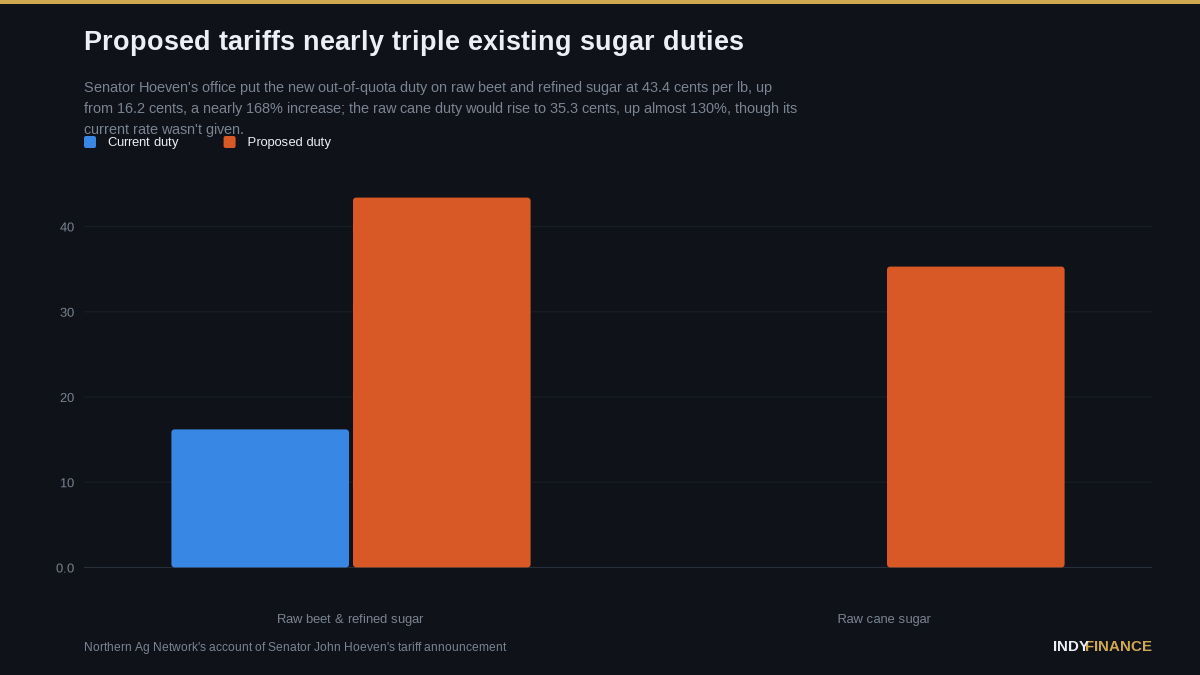
The sugar levy is separate from the 14-country tariff round announced the same day. It is a change to the Section 301 probe (a trade-retaliation investigation) into Brazil. Reuters put the new duty on raw sugar at $440 per metric ton. Northern Ag Network's account of Senator John Hoeven's announcement said rates on raw beet and refined sugar would rise nearly 168%, from 16.2 cents to 43.4 cents per lb. Raw cane rates would rise nearly 130% to 35.3 cents. The duty applies to sugar from any country entering outside the low-tariff quota. Trade Representative Jamieson Greer said this was "to prevent a surge of sugar imports from other countries whose market Brazil could backfill." Broker StoneX estimated the total out-of-quota tariff would equal 193%.
The two sides of the sugar trade read the plan differently. "In our opinion, this move will hurt much more the American market than Brazil," StoneX analyst Marcelo Di Bonifácio Filho told Reuters, noting the US already imports little out-of-quota Brazilian sugar. The Sweetener Users Association, which represents US companies that buy sugar, said another tariff "would further increase the cost." Hoeven cited USDA data showing more than 1.12 million tons of out-of-quota sugar entered in the 2025/2026 marketing year, the second highest on record. He also cited a North Dakota State University study estimating losses of up to $1.8 billion for the domestic industry last year. Northern Ag Network's write-up added that the sugar in a chocolate bar has risen from 1 cent to only 2 cents since 1986, while the bar's retail cost is up nearly 400%.
The idea that tariffs are about power comes from a Reuters analysis, not from the White House. Citing people familiar with Trump's thinking, Reuters said he wants to show he can still drive economic policy as his legislative clout shrinks after the midterms. In those midterms, exit polls found two-thirds of voters said his tariffs hurt the economy. Yale's Budget Lab estimated tariffs raised household costs by $900 a year. Officially, White House spokesman Matthew Middleton framed the policy around "lopsided trade agreements" and said the administration would "continue fighting to lower costs."
Broader stocks moved less than sugar did. Indy Finance market data show the S&P 500 at 7,182.78, down 0.25% on the day; Reuters linked that decline to the tariff announcement. Germany's DAX stood at 24,702.13, down 1.26%, Indy Finance data show, though none of the coverage explained that move.
Nothing is in force yet. The sugar proposal faces a 45-day public comment period, with implementation expected within 45 to 60 days, according to Northern Ag Network. Greer told CNBC he did not expect any of the new tariffs to take effect earlier than a couple of months from now.